Materials characterization
Composition, particle morphology, phase, porosity, and contamination.

APPLICATION DIRECTION
Relate electrode morphology, materials characterization, cycling history, manufacturing conditions, and failure mechanisms.
Battery & Energy StorageAPPLICATION DIRECTION
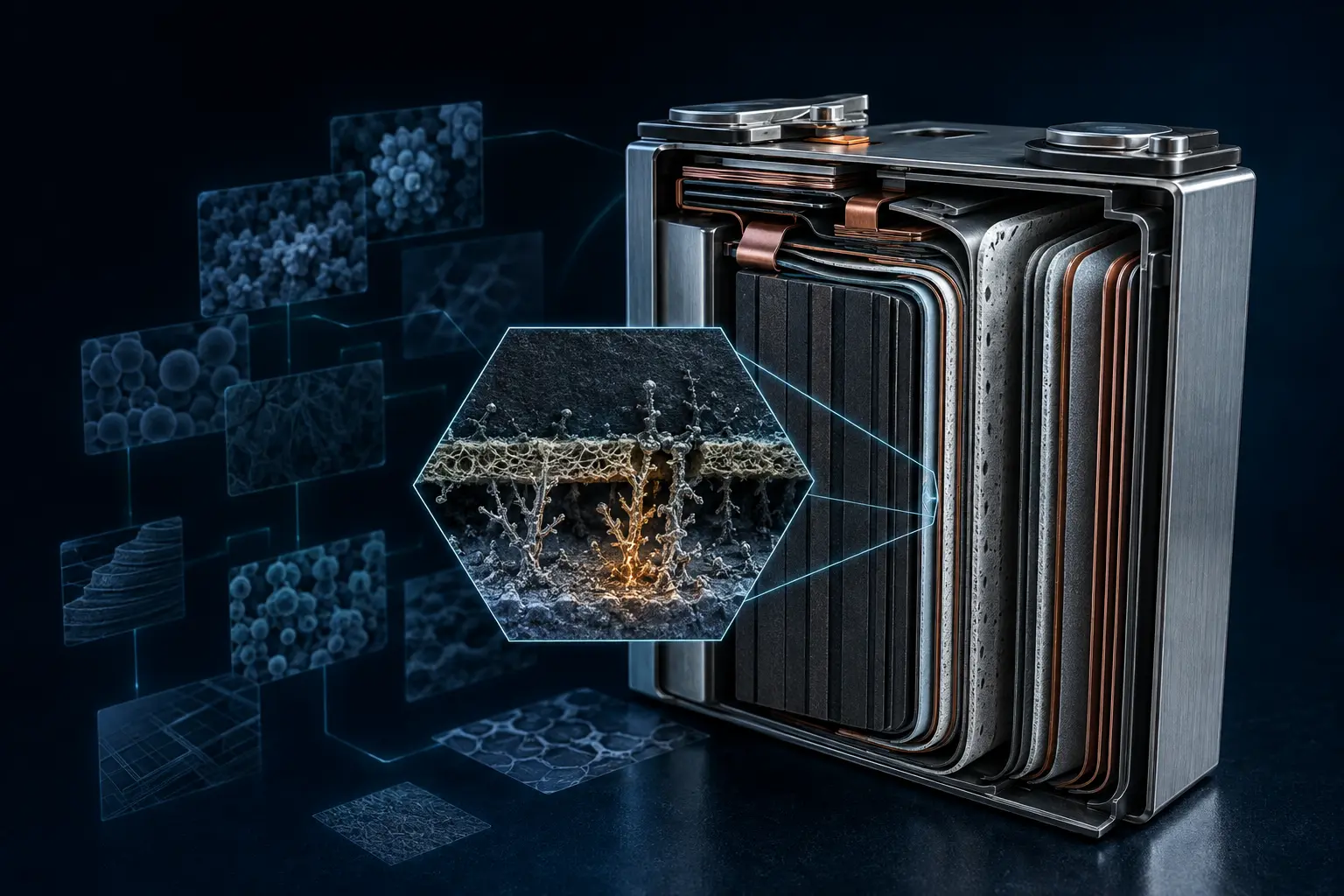
THE KNOWLEDGE CHALLENGE
Battery behavior emerges from interactions across materials, interfaces, manufacturing, environment, and time—not from a single measurement.Evidence becomes more valuable when its relationships survive.
THE EVIDENCE FIELD
Apverion is designed to preserve not only the artifact, but the conditions, reasoning, and decisions that give it engineering meaning.
Composition, particle morphology, phase, porosity, and contamination.
Coating, calendaring, formation, assembly, and environmental conditions.
Protocol, temperature, capacity, impedance, and performance change.
Cracking, plating, dendrites, delamination, and interface evolution.
Failure mode, containment, corrective action, and validation.
REPRESENTATIVE APPLICATIONS
Connect capacity loss with morphology, chemistry, interfaces, and cycling conditions.
Preserve why one chemistry or morphology advanced while alternatives did not.
Relate cell performance to process conditions and inspection evidence.
Build a traceable evidence chain from event to mechanism and corrective response.
POTENTIAL OUTCOMES
01Faster comparison across cell histories
02Stronger material-to-performance learning
03Earlier recognition of recurring mechanisms
04Better continuity from research to production
This page describes Apverion’s intended application direction for battery & energy storage. Specific capabilities and integrations will be validated with domain partners and qualified practitioners.